Comparing Crypto Coins
Learning the difference between the coins we offer
Written By _flush_f0x_
Last updated 14 days ago
We have a full guide to each of the six coins you can use on Flush.io. This article brings them together so you can see how they compare at a glance and choose the one that fits how you like to play. The good news up front: there is no wrong choice here. Every coin covered gets your funds in and out reliably; they simply differ in speed, cost, and whether their value holds steady or moves with the market.
The first thing to understand: two families
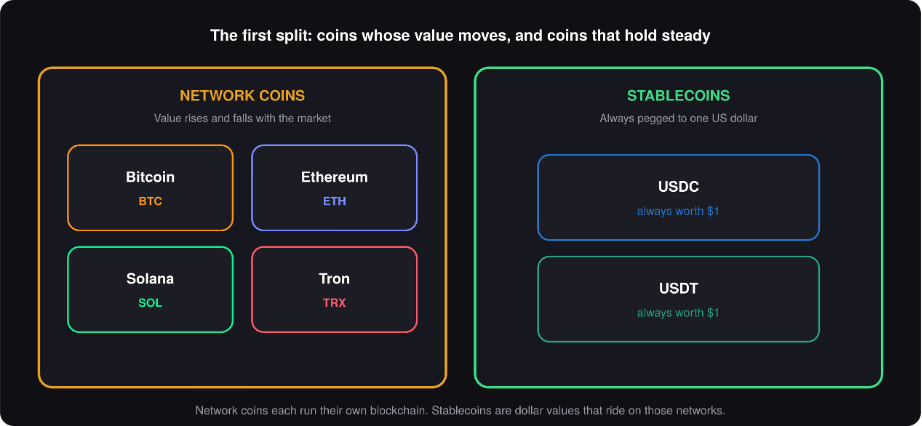
Figure 1: network coins move with the market, stablecoins hold at one dollar
The single most useful distinction is not between individual coins but between two families. Network coins, Bitcoin, Ethereum, Solana and Tron, each run their own blockchain, and their value rises and falls with the market. Stablecoins, USDC and USDT, are designed to always equal one US dollar. If price stability matters to you while you play, a stablecoin keeps your balance steady; if you are comfortable with value moving, a network coin is completely fine too. This one choice narrows things down faster than any other.
Speed and cost, side by side
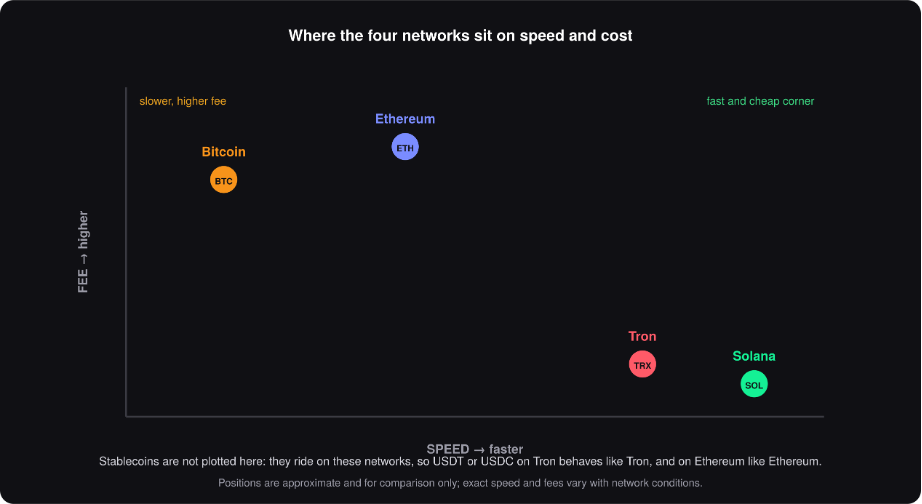
Figure 2: the four networks mapped by speed and fee
Among the four network coins, there is a clear pattern: the newer networks tend to be both faster and cheaper. Solana and Tron confirm in seconds for a fraction of a cent, Ethereum sits in the middle with fees that rise when it is busy, and Bitcoin is the slowest and often the most expensive per transfer, in exchange for being the most established. Stablecoins do not appear on this map because they ride on these networks: USDT or USDC sent over Tron behaves like Tron, and over Ethereum behaves like Ethereum. In other words, your rail choice sets the speed and fee, whichever coin you send.
The full comparison
Reading the table, the network coins each have a distinct character, while the two stablecoins are best thought of as near-interchangeable for everyday use: both hold a dollar, both are widely supported, and both let you pick a fast, cheap rail like Tron’s TRC-20. The choice between USDC and USDT usually comes down to which your wallet or exchange makes most convenient.
Pick by what matters most to you
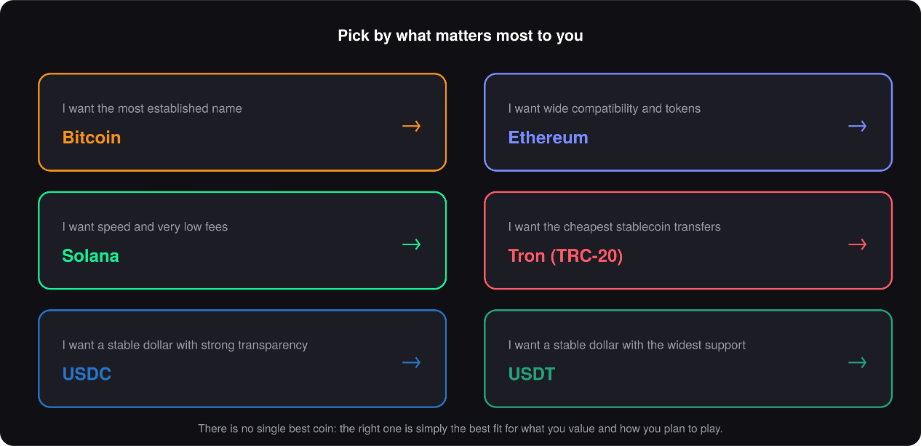
Figure 3: match a coin to your priority
If you are still unsure, start from what you care about most rather than from the coins themselves. The table below turns the most common priorities into a starting point. None of these are the only right answer; they are simply sensible defaults for a given preference.
A few honest generalisations
For most everyday play, a stablecoin on a fast rail is hard to beat. USDT or USDC sent over Tron gives you a steady dollar value, near-instant transfers, and tiny fees, which suits regular deposits and withdrawals very well.
Bitcoin and Ethereum shine if you also hold crypto. If you already own or want to hold BTC or ETH beyond playing, using them to deposit is convenient, just allow a little more time and fee than the faster networks.
Solana is the standout for speed. If getting back to playing quickly matters and you do not mind a newer network, Solana is the fastest, cheapest of the network coins.
The rail often matters more than the coin. For stablecoins especially, which network you send on affects your fee and speed far more than whether you picked USDC or USDT.
You are never locked in. You can use different coins at different times depending on what suits the moment, and switching is simply a matter of choosing a different option on the deposit page.
Good to know
Every coin here uses the same golden rule. Whichever you choose, always match the coin and network shown on the deposit page, as covered in our crypto rails guide: this matters for all of them equally.
Stablecoins remove one thing to think about. With a network coin, the market value can change between depositing and playing; with a stablecoin it does not, which some players simply find more relaxing.
Fees are always shown before you confirm. Whatever the general patterns above, the exact fee and estimated time appear before you send, so you can always compare in the moment.
Read the individual guides for depth. Each coin has its own detailed article covering how it works and how to use it; this comparison is the map, and those are the close-ups.
Play your way. The best coin is genuinely the one that fits your style: pick the family and speed that suit you, set your budget, and enjoy how quickly crypto gets you playing.
Was this helpful?
Still need help? Ask the team